
Shoreline defense that outperforms rock and installs like precast.
SECS® precast concrete modules cut wave transmission, scour, and overtopping past what conventional rubble-mound and seawalls achieve independently verified by USACE ERDC-CHL and Texas A&M. DCCI brings 65+ years of Texas Gulf Coast marine construction to every install.
Wave Transmission Coefficient (Kt) — Breakwater Config, Matched Freeboard
One structure, four jobs at once
Conventional breakwaters solve one problem and shift the rest downstream. SECS is engineered so hydraulic, structural, sediment, and ecological performance work together instead of trading off against each other.
Hydraulic Dissipation
An internally baffled flow path breaks up wave energy before it reaches the shoreline or structure.
Load Distribution
Interlocking modules behave as a continuous mat foundation, spreading bearing pressure across the run.
Sediment Continuity
Permeable geometry lets sand keep moving through the structure instead of stalling littoral transport.
Ecological Integration
The same apertures that dissipate energy double as habitat substrate built to Engineering With Nature principles.
Performance, independently tested
Results from USACE ERDC-CHL (Vicksburg flume, Jan 2026) and Texas A&M RELLIS/EFDL, published in a 67-page comparative analysis against rock rubble-mound, stepped and smooth revetments, and vertical seawalls.
| Metric | SECS | Conventional Rock | Where SECS Wins |
|---|---|---|---|
| Wave transmission (Kt) | 0.216 | 0.49 | Transmission controlp = 0.0114 |
| Energy dissipation | 95.3% | 76.4% | Overtopping resistance |
| Scour at toe | ≤3% unit length | ~4× worse | Scour protection |
| Stability tested to | 40,000+ cycles | 1,000–5,000 cycles | Long-term durability |
Conventional rock remains competitive for fully submerged reef breakwaters (Kt 0.6–0.9 acceptable) or temporary/sacrificial structures. Effect sizes across comparisons: Cohen's d = 1.3–2.7, Bonferroni-corrected p-values of 10⁻³–10⁻⁵.
Tested by the people who write the standards
Vicksburg Flume, Jan 2026
Physical model testing at San Clemente, CA wave conditions, including full 100-year storm wave simulation up to 99% wave energy attenuation recorded.
16-Run Iribarren Matrix
College Station flume testing of the single-sided unit model across a full range of wave steepness and breaker conditions.
Copano Bay Pilot, Lamar TX
Field survey recorded 100% oyster cover in SECS module apertures evidence for SECS as restorative infrastructure, not just protection.
One module system, engineered per site
Interlocking precast units adapt to hydraulic and geotechnical demands from open beach to industrial waterfront.
Beaches & Dunes
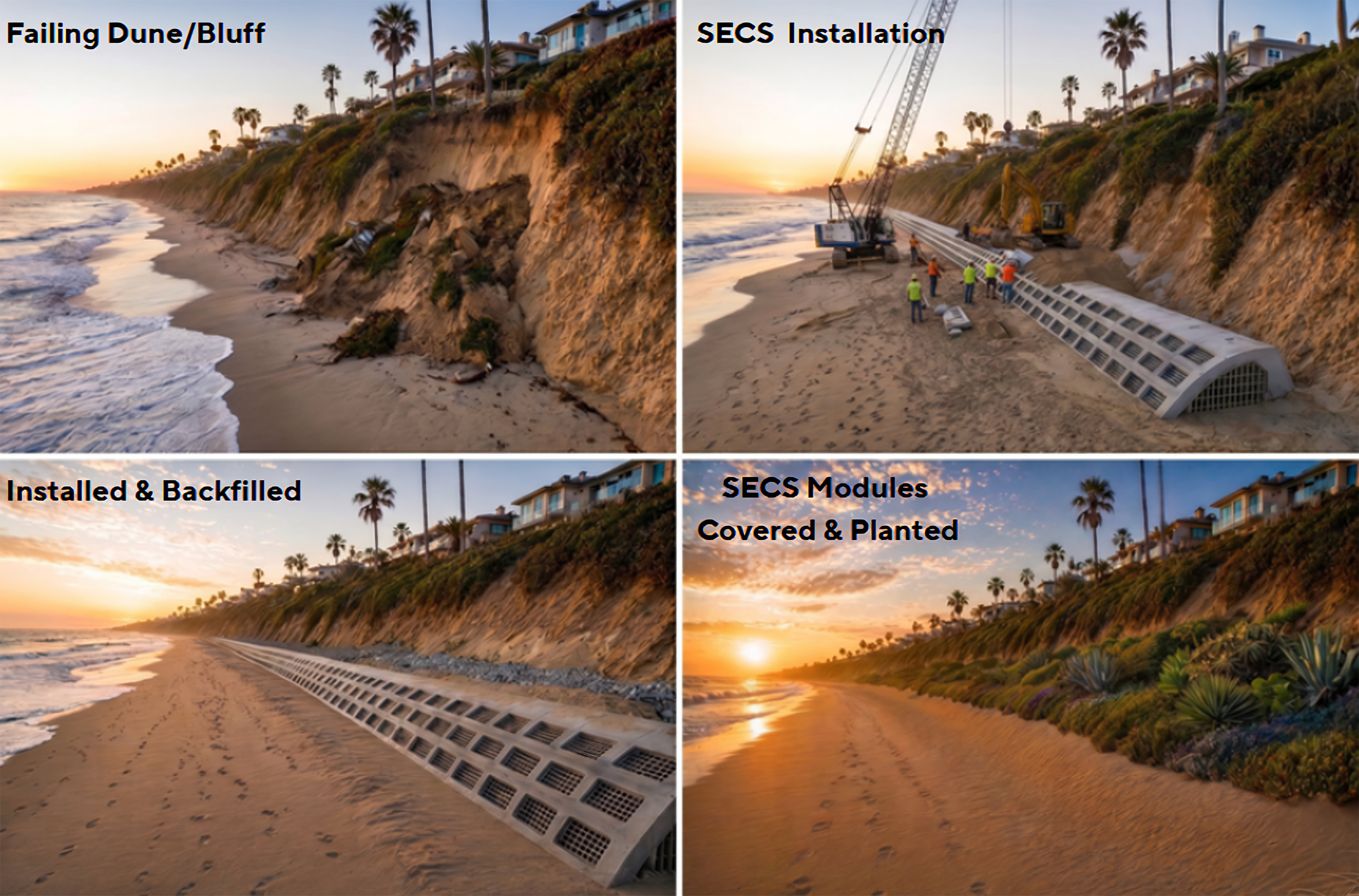
Structural resilient dunes — covered, planted, and backfilled behind failing bluffs.
Marinas & Ports
Wave attenuation and bulkhead protection under active vessel traffic and industrial loading.
Wetlands & Bays
Permeable geometry maintains littoral sediment transport in sensitive estuary environments.
Rivers & Waterfronts
Scour control and bank stabilization for high-flow and storm-surge-prone corridors.
From failing bluff to protected shoreline
A single install sequence: existing erosion, module placement, backfill, and full vegetative recovery.
Aligned with USACE & federal coastal resilience priorities
SECS is built to work with regulators, not around them integrating structural performance with the nature-based frameworks agencies already require.
Built off-site. Set on-site. Fast.
Prefabricated units mean no formwork and no cure time in the field DCCI crews move straight to placement.
Delivery
SECS modules staged at the installation location by barge or land transport.
Site Prep
Subgrade and geotextile preparation ahead of module placement.
Set
Crane or excavator lifts and sets each module into the drop-and-lock sequence.
Repeat
Steps 2–3 continue down the run until the full project length is complete.
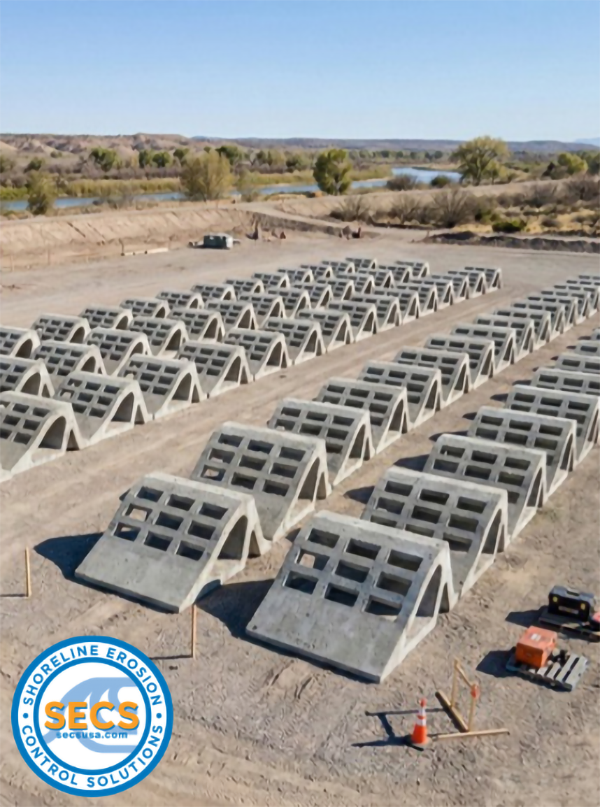
- Consistent ManufacturingRepeatable, controlled production not variable natural materials means consistent geometry and unit weight on every module.
- Reliable SupplyScalable production capacity keeps large-scale infrastructure and shoreline stabilization projects on schedule.
- Predictable Field PerformanceConsistent units mean predictable handling and placement productivity, with fewer field adjustments and no rejection for size or gradation non-compliance.
- 75-Year Design LifeEngineered for extreme hurricane conditions across a 75-year service life.
Derrick Construction has built the Texas Gulf Coast since 1959.
DCCI is HUB-certified, Woman-Owned, bonded and fully insured for land and marine construction and is a certified SECS installation contractor across bays, canals, and estuaries along the Texas coast.